National schools evolved after the sucsess of British Schools which were started in 1810. The National Society for the Education of the poor was formed in 1811, and there were 17,000 schools by 1851.
Schools provided before 1902 for mass education were sponsored either by the Church of England through the National Schools Society and therefore called National Schools, or by non-conformists through the British & Foreign School Society, and thus called British Schools. Such schools were all largely maintained by voluntary effort, but from the 1830's could attract Government grants. Eventually, government began to impose administrative requirements on those schools receiving grants, such as inspection, higher performance, compulsory attendance, and a compulsory leaving age. Ultimately the 1902 Education Act brought all these schools under state control, to be administered by the appropriate local authorities.
More information on the history of Peterborough schools:
http://www.peterborough.gov.uk/leisure_and_culture/libraries/local_studies_and_archives/online_info_on_collections/a-z_guide/q-z/schools.aspx
In the 1851 census (Peterborough District 8) there is no mention of the school. Ann Chappel, 76, an annuitant lives 2 doors away from the Blacksmith. Frances Phillipp, 65, has occupation school mistress, she is a widow living with her son John 33, a gardener. Elizabeth Clark 17, unmarried and living with her parents (Luke Clark, 50, Cattle Dealer & Mary A Clark 49), is described as a governess.
In 1861 Census the National School is 2 doors away from the Blacksmiths, but there is no one living on the premises, and no one with the profession teacher in Peterborough District 19 which covers Dogsthorpe and Garton End.
In the 1871 census (Peterborough St Paul District 23) the National School is simply marked as an uninhabited building 2 doors away from the blacksmith. There is Mary Bailey 42, a school mistress and grocer, living in Garton End. She was born in Peterborough, but her 2 children aged 5 and 3 were born in Sutton Surrey. Susan Plant, 15, is living in Dogsthorpe Lane, New England, with her father a brickmaker and the rest of her family, and has the occupation teacher at school.
In the 1881 Census (Peterborough District 32) Mary Bailey is still living in Garton End, at the grocers shop next door to the Comet. She is no longer head of the household her husband George has joined her, his occupation is shopkeeper, no mention of school mistress.
In the 1890 Kelly's Directory:
National School (mixed), Dogsthorpe, built in 1876 for 110 children; average attendance 84; Mrs Harriet Cook mistress.
From the Northampton Mercury 15 Sept 1893 Dogsthorpe National school had an average attendance of 87, and a Parliamentary grant of £67 4s. 6d.
In the 1911 Census
Jessie Brown 15, daughter of the landlord at the Bluebell Inn is described as a School Teacher working for the County Council.
In the 1914 Kelly's Directory for Northamptonshire:
Public Elementary School (mixed), Dogsthorpe. Built in 1876, and enlarged in 1896, for 140 children: Miss Ellen Young, mistress.
From John Crunkhorn's Memories of Peterborough:
"The next building was the village school, built in 1852/3 it consisted of 3 rooms, one of which was divided by screens to make 4 rooms. The school was a Church of England school and was overseen by Canon Lethbridge of Paston. The teachers when I and my brother attended were Misses Brookes and Bellairs in the infant reception and Miss Sally Herbert and Mr Roger Baker in the senior school. Miss Herbert was renowned for her handwriting - even obtaining thick and thin strokes using chalk on the blackboard."
"It closed as the main school when the new Dogsthorpe Estate was being developed in 1950's but used as an annexe until 1958. It was sold by Auction, and was used as a builders store by Mr Fairchild until eventually being demolished in 1994 to make way for the new houses in Fairchilds way." I am surprised by the late date of its demolition as I lived in Dovecote Close from 1984 - 1988 and I don't remember it.
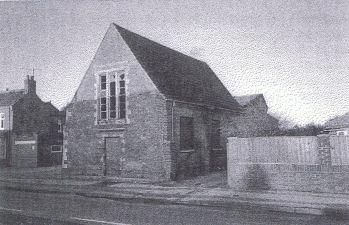
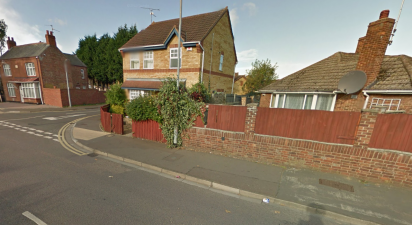
The Village School and the site of it today.
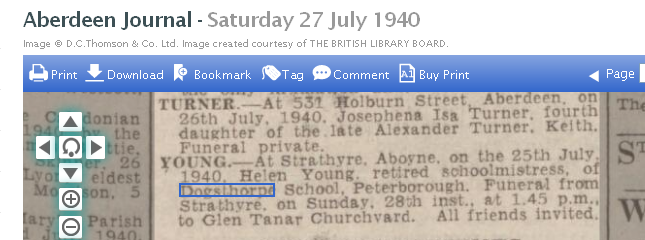
From this snippet a search on Ancestry showed that Helen Young was born in Aberdeenshire in 1855.
In the 1901 census she is 46 and lodging with the Twelvetrees in Dogsthorpe. Charlotte Hutcherson 27, is also boarding, she is an assistant teacher.
In the 1911 census she is Head Teacher of Elementary School and now has her own place at 1Olive Terrace, St Pauls Road, she has a boarder Charlotte Huskinson, 37, who is her assistant at school, born Lillington, Cambs. and they are living in just 2 rooms.
Going back to the 1891 Census Helen Young is living in School Cottage, Litlington, Cambs. Charlotte Hutcherson is her lodger, and at 17 is Monitress in School.
So having lived together for over 20 years perhaps there was more to their relationship than just teacher and assistant? I think this is proved by the probate notice:
Hutcherson Charlotte of The Laurels, Dogsthorpe, Peterborough, spinster died 4 May 1936 Probate Peterborough 8 June to Helen Young spinster. Effects £532 8s 4d.
So perhaps Helen returned to Scotland after the death of Charlotte, and lived there for the few years before her own death.
The Laurels mentioned in the notice was occupied by Mr and Mrs Letch in 1933 and had been for 40 years.
~~~~~~~~~~~~~~~~~~~~~~~~~~~~~~~~~~~~~~~
For more about the 1851 school see Glynn Barlett's description.