William Kitchen Parker
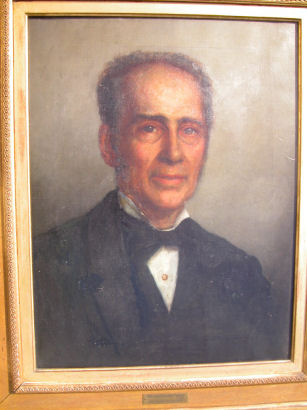
Extract from Chapel Centenary Article1
"Another son of the elder Thomas Parker had a notable scholastic and professional career after starting with a chemist in Stamford. He became a great scientist and doctor, a Professor of the Royal College of Surgeons, and a Fellow of the Royal Society. Withal he was a deeply religious man, and had a great interest in the little chapel at his old home. He died in 1890. No members of the family are now associated with the chapel."
"He married a farmer’s daughter, Sarah Kitchen, and it was to their youngest son that they gave him Kitchen as a Christian name. The name William Kitchen Parker was known by every scientist and man of of eminence in Great Britain. He was educated at King’s School, under the headmastership of the Rev. William Cape. He started his career as an apprentice to a druggist named Woodroffe at Stamford. He ultimately became a famous surgeon, was Hunterian Professor of Anatomy and Phsychology of the Royal College of Surgeons, and a Fellow of the Royal Society. The science of the world today is the richer for his researches on the Foraminifera and on the Vertebrate Skeleton, and for his learned writings. Like so many great scientists he was an intensly religious man and it has been said of him “from his fifteenth year to his death he kept undimmed by illness or sorrow an abiding sense of the Divine presence. He died on the third day of June 1890, and was buried by the side of his wife in Wandsworth Cemetery."
William Kitchen Parker has a very comprehensive article in
Wikipedia.
Thank you to Guy H. Ingram for the following information and the pictures of WK Parker.
W.K.`s daughter Sarah married my great grandfather Samuel Duggan Ingram (1846-1935) in Horseferry Road ,Wesylan Chapel,Westminster on October 1st,1874. They were the first couple to be married in this chapel and I have a bible presented to them by the Trustees,to commemorate this event.
I attach a copy of a painting of W.K. P. possibly commissioned when he was elected to the Royal Society,and a photograph of him and his family probably taken in Upper Tooting his final home about 1888-1889
I can positively identify in the photo below (seated bottom left) younger son, Professor William Newton Parker, Professor of biological sciences at University College of South Wales and Monmouthshire, and his elder brother (standing top right) T.Jeffrey Parker, Professor of biological sciences at Otago University, New Zealand. W.K.P. had seven children in all.
Guy H. Ingram
I was contacted by Rosi Crane from New Zealand, who is studying TJ Parker, and suggested that he would have been in New Zealand at the time the above photo was taken.
I then did a bit of digging on Ancestry and found that none of William Kitchen Parker's younger sons married before 1890. Taking the clue from Guy's comments above that Sarah Parker had married Samuel D Ingram in 1874, I found they had six chidren all born before 1887, which I believe correspond to the children in the photo. It would also make sense for the photo to be Guy's Great Grandparents and to have been handed down the family.
- Dorothy N Ingram born 1887 (sitting on her mother's lap.
- Cyril P Ingram born 1883 (to the far right)
- Janet W Ingram born 1881 (leaning on WKP's lap)
- Anthony H Ingram born 1879 (lying in foreground)
- Percy C P Ingram born 1876 (standing left)
This just leaves Marion Caldicot Ingram born 1877 missing from the picture, however whilst her family were living in Newport Wales, in both the 1891 and 1901 Census Marion was in Weston Super Mare at a Private Girls School where her aunt Elizabeth A Ingram was Principal. In 1891 as a boarder, and in 1901 as Music Mistress. The school was staffed completely by relatives of the principal, her 5 daughters and 4 neices and her sister!
If this is Sarah's family the man standing behind her is likely to be her husband Samuel D Ingram. Sadly Sarah Ingram died in 1894, at 39.
I also discovered that William Kitchen Parker had died at his son's house in Wales, this made me wonder if the photo may have been taken in Wales, and as Guy had said, the younger man could be Professor William Newton Parker with his fiance / wife Hedwig (married 1889) sitting behind him. They also lived in South Wales.